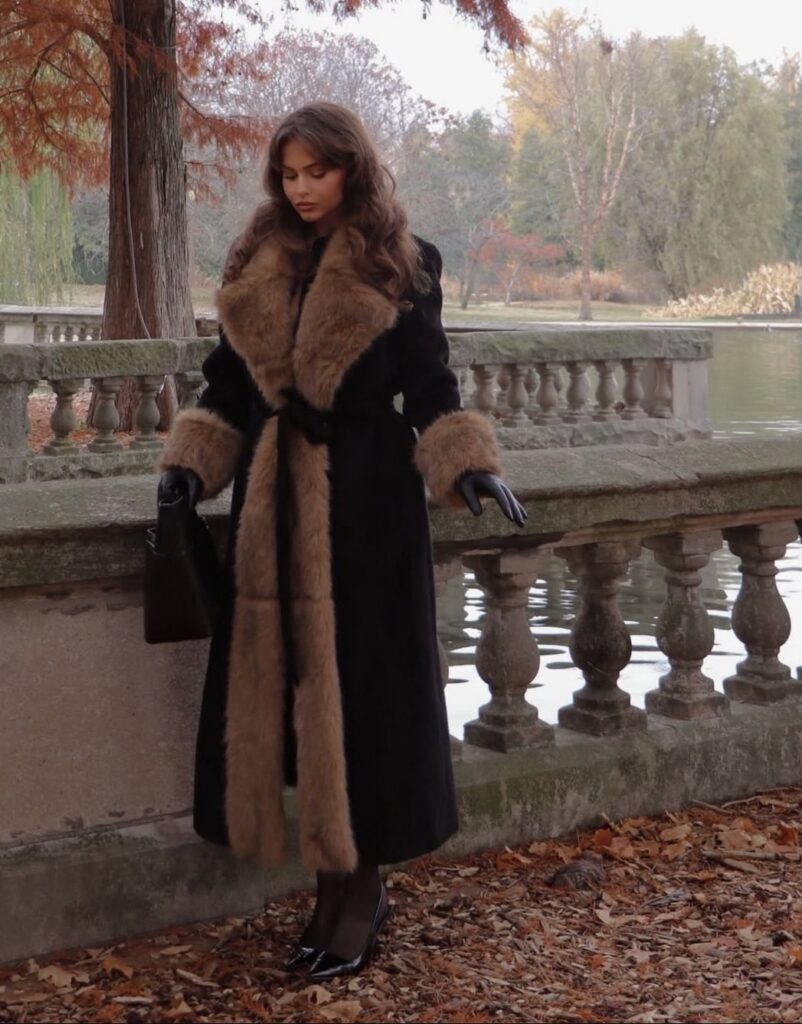
Russian fashion for women runs from a single sharp coat on the street to full formal ornament in the historical sections ahead, and the deciding factor is the occasion you are dressing for and what you already own.
A below-the-knee coat with fur trim over quiet basics handles cold-weather street style, and handworked embroidery on white linen carries the same eye for craft into summer occasions where simpler pieces would fall flat.
1. Russian Street Style

Russian street style layers a sharp coat over whatever you already own. A black base with fur trim gives the coat its structure, and gloves that reach past the wrist keep the silhouette long.
I would start with a single statement outer piece, something that hits below the knee, and let the rest stay quiet.
This works for anyone whose closet already runs toward neutrals and who needs one upgrade to look pulled together in cold weather. Proportion matters: the coat should outweigh what is underneath, not compete with it.
A cream version with a plaid skirt reads more polished; black with fur trim reads tougher. Pick based on whether your days lean office or evening.
Quality matters more than label mix. One heavy coat plus a graphic tee and mid-range boots gets you there.
2. Traditional Russian Clothing

Traditional Russian clothing centers on embroidery that carries actual regional patterning, not generic folk print. Red geometric work on white linen, bell sleeves cut wide enough to move, and a waistline that sits natural rather than cinched define this cut.
That combination still works now for outdoor summer events where a floral sundress would look out of place.
The embroidery itself is what signals intention; machine copies flatten the geometry, so handwork or high-quality reproduction matters more than exact historical accuracy.
Best for readers who already own one piece with real craft detail and want to build an outfit around it, or who need a wedding or garden party option that is not another slip dress.
3. 90s Russian Fashion

Nineties Russian party dressing went heavy on structure and shine at once. Metallic gowns with built shoulders, wide gold belts, and jewelry that reads as armor more than accent carried the 90s Russian look.
Hair is full, not sleek; the overall effect is deliberate excess after years of scarcity.
To wear this now without looking like a theme party, I would isolate one element: the shoulder line, the metallic fabric, or the statement belt, never all three. Volume in the hair or one bold earring finishes it.
This suits someone who already owns one piece from that era, a relative’s belt or a thrifted jacket, and wants to use it rather than archive it.
The risk is looking costumed; the win is wearing something with actual memory attached.
Sergei Pakhotin, the 32-year-old founder of clothes brand Sputnik 1985, agrees the political climate could be a factor in Russia’s fashion resurgence in the West.
4. 2000s Russian Fashion

Two-thousands Russian fashion mixed military surplus with club minimalism in ways that only make sense if you remember both happening at once.
The escalator photo pairs a grey mini dress and leather jacket against flared jeans and a red military coat; one look is sleek, the other is layered, and both rely on low-rise bottoms that sit at the hip.
The usable carryover is the contrast between a short sharp dress and a heavy jacket, or between a fitted military coat and wide pants. One piece structured, one piece relaxed.
This style rewards someone who shops secondhand and can spot a genuine military jacket among reproductions. The accessories matter less than the proportion play; skip the bunny ears unless you are under twenty-five and committed.
5. 1910s Russian Fashion

Early twentieth-century Russian dressing ran toward high necklines, long lace sleeves, and waist definition that came from cut rather than cinching.
Cream lace in vertical panels, a braided updo that keeps the neck visible, and gloves that extend past the wrist balance the sleeve volume.
I would wear this silhouette to a formal daytime event, not evening; the cream and the coverage read wedding guest or garden party rather than gala.
The choker detail is optional, but the sleeve length is not: three-quarter or full, never short, or the proportions collapse.
Best for readers who need one formal look that covers arms and decolletage without looking conservative. The fabric should be light enough to move; heavy lace reads curtain.
Check the back view before buying; the V-neck reverse is often where this cut surprises you.
6. 19th-century Russian Fashion

Nineteenth-century Russian formal dress piled on ornament in deliberate display of rank and region. Off-shoulder construction, lace ruffles that extend past the neckline, and a forehead jewel anchor the whole look.
Gold embroidery and patterned borders on the skirt complete the effect; nothing is left plain.
To adapt this now, I would take one layer of excess and stop. The off-shoulder cut alone, with simple earrings.
Or the ruffle detail on a modern neckline, with clean hair. The full assembly is for stage or committed historical recreation; isolated, each element still reads as choice rather than costume.
This rewards a reader who has an event with an actual dress code, or who collects one dramatic piece to wear with jeans on a night when standing out is the point.
The headpiece in particular needs confidence; without it, the dress still speaks.
Frequently Asked Questions
What is a famous Russian clothing brand?
Gosha Rubchinskiy and Sputnik 1985 are two of the better-known names.
Gosha built a following by mixing post-Soviet street references with sportswear shapes, while Sputnik 1985 works in a similar lane with graphic-heavy pieces that read clearly as Russian rather than generic Eastern European.
Both matter more to people who follow fashion as culture than to someone shopping for a coat.
What is traditional Russian clothing?
Regional geometry is the real signature: each area had its own stitch vocabulary, so the pattern on a Kostroma blouse reads differently from one made in Vologda.
A practical take keeps the red threadwork on white ground, lets the sleeves flare without swallowing the arm, and leaves the waist where it naturally falls.
Hand stitches carry the meaning; factory versions lose the dimension, so I look for honest reproduction over museum-grade accuracy.
What did Russian royalty wear?
Court dress in 1800s Russia layered every surface with ornament because restraint signaled lower standing.
The silhouette broke at the shoulders, spilled lace past the collar, carried a jeweled band across the forehead, and ran gold thread along skirt hems already thick with pattern. Nothing was left plain.